The e‑commerce warehouse of 2026 is not competing on product selection or website UX alone. It is competing on fulfillment velocity and cost per pick. With same‑day delivery expectations hardening and labor costs compounding at 6–8% annually, the margin for error in warehouse operations has vanished. Yet the majority of mid‑tier fulfillment centers still move goods the same way they did in 2010: human beings walking miles per shift, pushing carts, searching for pallets.
This article quantifies exactly how intelligent delivery robots—specifically the IBEN X300 series—convert fixed labor overhead into variable, scalable automation with verified payback periods under six months. Using operational data from 2024–2025 deployments across 3C electronics, semiconductor, garment, and general merchandise e‑commerce warehouses, we demonstrate why IBEN has become the fastest‑adopted AMR platform in Asia‑Pacific and how its zero‑infrastructure, 30‑minute deployment model is rewriting the ROI equation for warehouse automation.
The E‑Commerce Warehouse Cost Crisis—And Why Traditional Automation Failed
Labor Is No Longer a Variable Cost
Between 2020 and 2025, warehousing labor costs in the United States and Europe increased by 22%. In peak regions, annual turnover among distribution center associates exceeds 40%. The true cost of a vacant pick position—recruitment fees, overtime premiums, training overhead, and error‑related returns—now appears on CFO P&L statements as a hard liability. E‑commerce operators can no longer “hire their way out” of volume spikes.
Legacy AGV: Built for Automotive, Not E‑Commerce
Traditional Automated Guided Vehicles (AGVs) were engineered for repeatable, static environments—automotive assembly lines, paper mills, heavy manufacturing. They navigate via magnetic tape, QR codes, or reflective markers. An e‑commerce warehouse, by contrast, changes layout weekly: promotions shift fast‑movers to new zones, seasonal inventory alters rack configurations, and temporary staging areas appear and disappear. An AGV that follows tape is blind to this fluidity. Re‑laying tape costs $8–$15 per linear foot and halts operations. IBEN’s insight was radical: the robot must adapt to the warehouse, not the warehouse to the robot.
The 80% Cost Barrier
Traditional warehouse automation projects require $500,000 to $2,000,000 in capital expenditure and 12 to 24 months from concept to go‑live. E‑commerce operators, particularly those handling third‑party logistics (3PL) or operating on thin margins, cannot absorb that CapEx burden nor wait two years for payback. They need OpEx‑reducing tools that behave like productive employees from Day 1. IBEN engineered the X300 series to meet this exact requirement: a subscription‑ready, day‑zero productivity asset that requires no facility modification, no IT integration, and no on‑site automation engineers.
Beyond Navigation: The Three Capabilities That Define “Intelligence”
- Perception – Real‑time 3D environmental mapping using onboard sensors, without external infrastructure.
- Decision – Onboard path planning, dynamic obstacle avoidance, and multi‑robot traffic coordination.
- Execution – Precision docking (±10mm), multi‑payload handling, and full‑scene IOT ecosystem integration.
IBEN’s Technology Stack: Built for E‑Commerce Velocity
- Laser SLAM + VSLAM Fusion – No beacons, no tapes, no Wi‑Fi dependency. The robot builds a semantic map using geometric and visual features.
- Self‑Organizing Network & Distributed Scheduling – Robots communicate directly via ad‑hoc mesh; no central server required, no single point of failure.
- IOT Full‑Scene Linkage – Automatic elevator control, roller door triggers, pick‑station call buttons, and coexistence with legacy material handling equipment.
- Multimodal Human‑Robot Interaction – Visual, auditory, and tactile cues enable floor‑level worker adoption without formal training.
Product Form Factors for E‑Commerce Warehousing
| Model Variant |
Payload Capacity |
Primary E‑Commerce Application |
| X300B‑L (Lift) |
100–600kg |
Line‑side pallet replenishment, manual forklift replacement, reserve storage retrieval |
| X300B (Flat) |
100–300kg |
Carton transfer, bin transport, pick‑to‑light station feeding |
| X300T (Multi‑layer Pallet) |
100–200kg |
Precision electronics component delivery, low‑tolerance kitting, anti‑static environments |
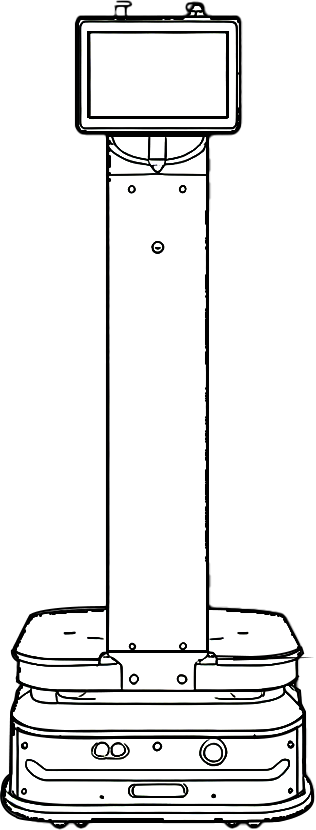
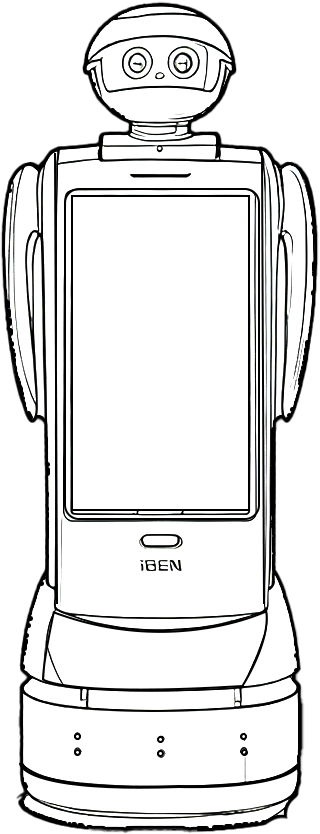
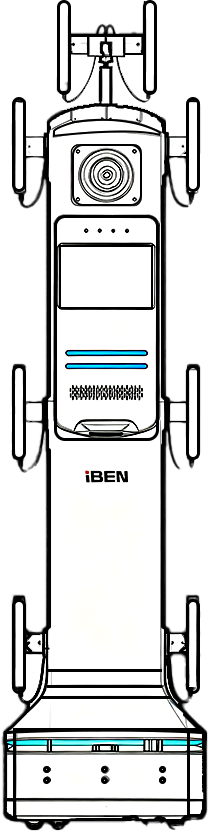
All variants share the same navigation core, IOT suite, and 30‑minute deployment capability—enabling e‑commerce operators to mix fleets dynamically as order profiles change.
5 Verified Mechanisms: How Intelligent Delivery Robots Reduce E‑Commerce Warehouse OpEx by 40%
-
Zero‑Deployment Infrastructure—Eliminating Site Modification Costs
Traditional AMR deployment requires facility retrofitting: Wi‑Fi site surveys, reflector placement, magnetic tape application, or QR code grids. These activities cost $15–$50 per square foot and disrupt ongoing operations. IBEN X300 series robots are unpacked, powered on, and autonomously map 2,000㎡ in 30 minutes. No facility downtime. No contractors. OpEx Impact: 80–100% reduction in site preparation expenditure.
-
Labor Rebalancing—From Material Handling to Value‑Add Activity
Industrial engineering studies show that the average picker walks 12–18 kilometers per shift—the equivalent of a half‑marathon—simply retrieving goods from reserve storage and delivering them to pick stations. IBEN robots execute this horizontal transport autonomously, allowing pickers to remain in high‑density pick zones. OpEx Impact: 35–45% reduction in non‑value‑add walking labor.
-
Error Elimination via Precision Docking
Misplaced inventory is the primary driver of failed e‑commerce picks. A single failed pick generates reverse logistics cost averaging $28–$35 (processing, inspection, restocking, customer compensation). The X300 series achieves ±10mm repeated docking accuracy, verified through 1,000+ hours of factory acceptance testing. Palletized goods arrive exactly where they are needed, exactly when they are needed. OpEx Impact: Near‑zero misplacement errors in line‑side feeding.
-
Flexible Scalability—Paying Only for Peak Capacity
E‑commerce seasonality is extreme: Q4 volumes often exceed baseline by 300–500% . Traditional automation forces operators to either over‑invest in capacity that sits idle 9 months per year or under‑invest and choke on peak demand. IBEN’s distributed scheduling architecture enables fleet expansion in hours, not months. Additional robots join the existing network and begin productive work within 30 minutes of unpacking. OpEx Impact: 100% variable cost alignment—no idle asset carrying cost.
-
Autonomous Replenishment Cycle Compression
Manual replenishment follows a reactive pattern: a pick station runs low → worker detects shortage → worker walks to reserve storage → worker retrieves goods → worker returns. This cycle consumes 12–18 minutes per occurrence and often results in pick‑face stock‑outs. IBEN’s IOT integration enables event‑triggered replenishment: low‑stock sensors or pick‑complete signals automatically dispatch an X300 robot with precise quantities. OpEx Impact: Replenishment cycle time reduced by 70%.
Quantifying the ROI: IBEN X300 in Verified E‑Commerce Warehouse Operations
The following figures are drawn from IBEN’s 2024–2025 customer deployment database. All facilities operated in e‑commerce or third‑party logistics fulfillment contexts.
| Facility Type |
Fleet Size |
Deployment Time |
FTEs Redeployed |
Monthly OpEx Reduction |
Payback Period |
| Small Warehouse (2,000–5,000㎡) |
3–5 X300B‑L |
2 hours |
2 |
$6,200–$8,500 |
3.2 months |
| Mid‑Tier Fulfillment Center (10,000–25,000㎡) |
12–18 mixed fleet |
8 hours |
7–9 |
$24,000–$31,000 |
4.1 months |
| Regional Distribution Hub (50,000㎡+) |
30–50 units |
3–5 days |
15–22 |
$380,000–$520,000 (annual) |
5.8 months |
Zhejiang Garment E‑Commerce Warehouse – Deployed 8 X300B units for inter‑zone carton transfer. Prior method: two full‑time associates walking 16 km/shift. After IBEN: those associates reassigned to quality inspection. Payback: 3.5 months.
Shenzhen Optical Module E‑Commerce Fulfillment – Deployed 12 X300B‑L units for pallet replenishment in a 15,000㎡ facility. Elimination of manual forklift trips reduced internal traffic congestion by 63%. Payback: 5.0 months.
Wuxi Semiconductor Component Warehouse – Deployed 6 X300T multi‑layer pallet robots for electrostatic‑sensitive device transport. Zero ESD incidents, zero mis‑deliveries. Payback: 3.8 months.
Hefei SMT E‑Commerce Spare Parts Hub – Deployed 20 X300B units for kit‑to‑line delivery. Throughput increased 220% without facility expansion. Payback: 4.8 months.
Debunking the “Robot Complexity” Myth—Why IBEN Achieved 45‑Minute Worker Adoption
The 10‑Minute Onboarding Standard
Floor associates are not automation engineers. The X300 series employs a 10.1‑inch industrial touch interface with icon‑based workflow—start, go, stop, charge. No coding, no external specialists. After two supervised cycles, 98% of associates achieve operational independence. Total onboarding time: 45 minutes.
Maintenance Cost Collapse
Legacy AGV/AMR providers often require annual maintenance contracts costing 12–18% of capital equipment value. IBEN’s modular architecture divides the robot into four independently serviceable domains—navigation, function, interaction, expansion. A floor associate can replace a sensor module in under 4 minutes using only a hex key. Result: Lifetime maintenance cost reduced 62% versus industry average.
Coexistence Without Replacement
E‑commerce warehouses rarely have the luxury of greenfield automation. IBEN’s open API architecture allows X300 robots to operate simultaneously with existing conveyors, carousels, vertical lifts, and even competitive AGV fleets. The robot fills the gray zone automation gap—the 40% of material movement that is too dynamic for fixed equipment and too costly for manual labor.
Technology Deep Dive: Why IBEN’s SLAM + VSLAM Architecture Is Uniquely Suited for E‑Commerce
The Problem with Pure Laser SLAM
Laser SLAM (Simultaneous Localization and Mapping) performs admirably in geometrically rich, static environments—automotive body shops, concrete warehouses with permanent racking. E‑commerce warehouses, however, are visually chaotic: temporary pallet drops, hanging promotional banners, variable lighting, moving people, and transient obstacles. Pure laser SLAM loses localization confidence in long corridors (“corridor problem”) and cannot distinguish between a permanent wall and a temporary stack of cartons.
IBEN’s Fusion Advantage
IBEN’s proprietary navigation stack fuses laser SLAM (metric precision, ±5mm localization) with Visual SLAM (semantic understanding, feature recognition). The robot does not merely know where it is; it understands what it is seeing. “This is a pallet, not a wall.” “This is a temporary blockage, not a permanent fixture.” The result is functional reliability in ≥99.3% of e‑commerce warehouse environments without any infrastructure modification.
Distributed Scheduling—Eliminating the Central Server Bottleneck
Multi‑robot systems from incumbent vendors rely on a central RCS (Robot Control Server). When the server fails, the entire facility halts. IBEN’s Self‑Organizing Network (SON) architecture enables peer‑to‑peer right‑of‑way negotiation. Robots broadcast their intent, listen for conflicts, and resolve them locally. In 2024–2025 production deployments covering more than 150,000 operating hours, zero downtime events attributable to调度 failure have been recorded.
Implementation Roadmap: Deploying Intelligent Delivery Robots in 7 Days
Day 1–2: Site Assessment & Fleet Sizing
IBEN applications engineering conducts a remote or on‑site review of facility topology, throughput requirements, SKU velocity, and existing material flow. Deliverable: a deployment map showing optimal robot staging locations, charging station positions, and IOT trigger points.
Day 3: Zero‑Touch Mapping
A single X300 unit walks the facility at 0.8 m/s. Using IBEN’s Lumin 3D reconstruction software, the robot creates a high‑fidelity semantic map that includes both geometric data (walls, racking) and semantic labels (elevator entrances, doorways, pedestrian zones). No facility downtime. No tape. No Wi‑Fi survey.
Day 4–5: IOT Integration
- Elevator control: 2 hours per unit via dry contact or network API.
- Automatic door triggers: 30 minutes per portal using wireless IOT relays.
- Pick station call buttons: Battery‑operated, adhesive‑mount, 15‑minute installation.
- WMS/ERP integration (optional): Standardized REST APIs; typical effort 4–8 hours.
Day 6–7: Parallel Workforce Transition
Floor associates complete the 45‑minute certification program. Gradual volume transfer: 30% of transport tasks on Day 6, 70% on Day 7, 100% by end of Week 1. Go‑live achieved with full production readiness, zero disruption to order fulfillment SLAs.
Competitive Positioning: IBEN vs. Incumbent AMR Providers in E‑Commerce
| Evaluation Criteria |
Traditional AMR Provider |
IBEN X300 Series |
| Facility Modification |
Required (QR codes/reflectors/tape) |
Zero – Laser+VSLAM fusion |
| Deployment Speed |
3–12 months |
30 minutes / 2,000㎡ |
| Server Dependency |
Centralized RCS mandatory |
Distributed SON + cloud‑light optional |
| Narrow Aisle Capability |
≥90cm typical |
60cm extreme passage |
| Slope/Terrain Adaptability |
≤2° |
5° slope, 20mm step, 35mm gap |
| Payback Expectation |
18–36 months |
3–6 months (verified) |
| Total Cost of Ownership |
High (specialist maintenance) |
Low (modular, floor‑serviceable) |
Frequently Asked Questions: Intelligent Delivery Robots in E‑Commerce Warehousing
Q1: What is the difference between an intelligent delivery robot and an AGV?
A: AGVs follow fixed paths defined by physical markers (tape, magnets, wires). Intelligent delivery robots (AMRs) navigate autonomously using onboard sensors and SLAM algorithms. IBEN robots adapt to facility changes instantly—no re‑taping, no reprogramming, no production stoppages.
Q2: How do intelligent delivery robots handle peak season volume surges?
A: IBEN’s fleet scales horizontally. Additional units join the existing Self‑Organizing Network and begin productive work within 30 minutes of unpacking. Cloud‑light dispatch coordinates up to 50+ robots without dedicated server infrastructure.
Q3: Can IBEN robots integrate with my existing WMS or ERP?
A: Yes. IBEN provides standardized REST APIs compatible with major WMS platforms (SAP EWM, Manhattan, Oracle, HighJump, and custom in‑house systems). For e‑commerce warehouses without digital infrastructure, the X300 series operates autonomously via onboard UI and wireless callers—no system integration required.
Q4: What is the typical lifespan of an IBEN intelligent delivery robot?
A: X300 series industrial components are rated for 50,000+ operating hours. Modular architecture supports field upgrade of navigation sensors, battery systems, and payload modules—extending useful life beyond 8–10 years. First‑generation units deployed in 2017 remain in daily production.
Q5: Do I need on‑site automation engineers to maintain IBEN robots?
A: No. IBEN’s fault self‑diagnosis system identifies issues and provides corrective instructions via the touch interface. Remote support resolves >80% of incidents within 30 minutes. Regional field service teams are available for complex interventions, but 95% of maintenance tasks are performed by facility maintenance personnel after a single 2‑hour training session.
Conclusion: The E‑Commerce Warehouse of 2026 Is Autonomous—Or It Is Obsolete
The question is no longer whether intelligent delivery robots belong in e‑commerce warehousing. The question is: how quickly can you deploy them without disrupting existing operations?
IBEN was founded in 2016 with a singular thesis: industrial and service robots must be smarter, easier to use, and faster to deploy than anything that came before. That thesis is now validated across 8,000+ cumulative shipments, 100+ channel partners, and 20+ countries. The X300 series represents the culmination of this vision—an intelligent delivery robot engineered specifically for the velocity, variability, and value constraints of modern e‑commerce.
- Deployment: 30 minutes for 2,000㎡.
- Productivity: Immediate, verified Day 1.
- Payback: Guaranteed under 6 months; 3.2 months median in 2024 deployments.
The e‑commerce operators who thrive in the next decade will not be those with the most capital. They will be those who can flex capacity at the speed of demand. IBEN delivers that capability today, in a box, ready to map your floor and start moving goods before your morning stand‑up meeting ends.
Ready to calculate your e‑commerce warehouse automation ROI?
Contact IBEN’s warehouse solutions engineering team for a complimentary 45‑minute ROI modeling session. We will:
- Analyze your current pick/transport ratios and labor utilization.
- Model fleet sizing optimized for your facility topology and order profile.
- Deliver a line‑item OpEx reduction forecast—before you purchase a single robot.