The autonomous mobile robot market is projected to reach $200 billion by 2030, and hundreds of companies now call themselves “automation robot manufacturers.” Beneath the surface, a deep divide separates full‑stack innovators—who control every layer of the technology stack—from assembly‑only brands that integrate third‑party components into a branded chassis. For procurement leaders and plant engineers, distinguishing between these two models is the difference between three‑month ROI and stranded assets.
This article provides a technical due diligence framework—seven non‑negotiable capabilities—to evaluate automation robot manufacturers before you commit capital. Each capability is drawn from IBEN’s decade of in‑house R&D and validated across 8,000+ industrial deployments.
Why “Automation Robot Manufacturer” Is Not a Monolithic Category
Assembly‑only brands exploit low barriers to entry: off‑the‑shelf lidars, open‑source navigation stacks (ROS), generic motor controllers, and contract manufacturing. They excel at marketing but consistently exhibit:
-
Localization drift in long corridors
-
Inability to optimize power for 24/7 operation
-
Firmware regressions from upstream component changes
-
Customization dead‑ends requiring complete redesign
Full‑stack manufacturers like IBEN control hardware, firmware, algorithms, and cloud platforms. IBEN was founded in 2016 and now holds 500+ IP assets, 100+ authorized patents, and a 50%+ R&D headcount ratio—enabling co‑optimization across every layer of the robot.
Capability #1: Proprietary Navigation Stack (Not Wrapped Open‑Source)
Open‑source navigation libraries (ROS Navigation, Cartographer) exhibit well‑documented weaknesses in production: drift in symmetric corridors, kidnapped‑robot failure, and semantic blindness (cannot distinguish walls from temporary pallets). Vendors who wrap these libraries pass the engineering burden to you.
IBEN’s Laser SLAM + VSLAM fusion combines metric precision (±5 mm) with semantic understanding. The robot recognizes corridor ends, permanent structures, and transient obstacles. Result: zero‑infrastructure deployment—no tape, no QR codes, no reflectors. 2,000 m² mapped autonomously in 30 minutes.
Capability #2: Distributed Scheduling Architecture
Legacy multi‑robot systems depend on a central Robot Control Server (RCS). When the server fails, every robot in the facility stops. Recovery costs hours of production.
IBEN’s Self‑Organizing Network (SON) enables peer‑to‑peer scheduling. Robots broadcast trajectories and negotiate right‑of‑way locally. A cloud‑light console is optional; operations continue even if the console is offline. Zero downtime events attributable to scheduling failure in 150,000+ operating hours. Adding a 50th robot requires no server upgrade—it simply joins the mesh.
Capability #3: Full‑Scene IOT Integration
A robot that cannot actuate its environment is half a solution. Assembly‑only brands provide “HTTP API documentation” and expect you to hire integrators at $150–$250/hour.
IBEN delivers a unified IOT integration suite developed through 2,000+ enterprise service robot deployments:
-
Elevator control: 2 hours per unit (dry contact or network API)
-
Automatic doors: 30 minutes per portal (wireless IOT relay)
-
Pick station call buttons: 15 minutes (battery‑operated, adhesive‑mount)
-
WMS/ERP integration: 4–8 hours (REST APIs with pre‑built adapters)
Coexistence: IBEN robots operate alongside existing conveyors, carousels, and competitor AGV/AMR fleets. No “rip and replace.”
Capability #4: Multimodal Human‑Robot Interaction
Complex HMIs increase training time and error rates. Many manufacturers treat HMI as an afterthought.
IBEN’s interaction layer is informed by 10 years of service‑robot UX:
-
10.1″ industrial touch panel – glove‑compatible, anti‑glare, IP54
-
Icon‑based workflow – four commands: Go, Stop, Charge, Mission
-
Multimodal feedback – 360° LED ring, voice prompts, vibration
Adoption metric: 98% of floor associates achieve independence after two supervised cycles. Total onboarding time: 45 minutes.
Capability #5: Modular Hardware Architecture
Monolithic designs turn a single sensor failure into a factory‑return event—freight, customs, weeks of downtime.
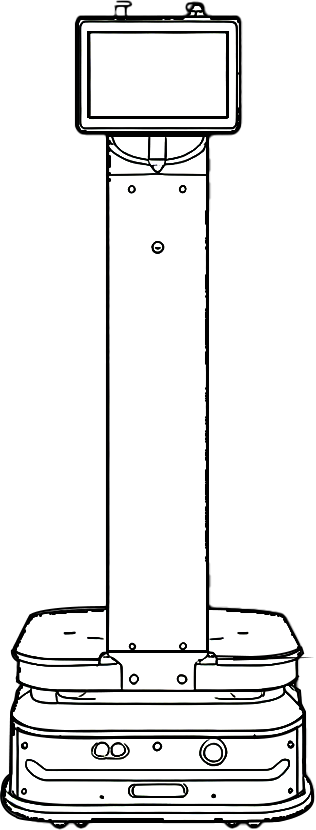
IBEN’s domain‑separated modularity divides the X300 into four independently serviceable domains: Navigation, Function, Interaction, Expansion. A floor associate replaces a lidar module in <4 minutes using a hex key. No recalibration, no firmware reflash.
Financial impact: IBEN customers report 62% lower lifetime maintenance cost versus industry averages (Material Handling Institute).
Capability #6: Extreme Environment Adaptability
Many AMRs stall on 3° slopes or refuse to cross 20 mm gaps, forcing costly floor grinding. IBEN engineers tested X300 across 40+ manufacturing sites:
| Parameter |
Typical AMR |
IBEN X300 |
| Slope negotiation |
≤2° |
5° continuous |
| Step climbing |
≤10 mm |
20 mm |
| Gap crossing |
≤20 mm |
35 mm |
| Narrow aisle |
≥90 cm |
60 cm |
Enablers: dual‑lidar (360° no blind spots), downward‑facing depth camera (negative obstacle detection), high‑torque motors (30% reserve), compliant suspension. No facility retrofitting required.
Capability #7: Verified Manufacturing Scalability
Startups often fail to transition from pilot runs to enterprise volume. Verify production discipline.
IBEN’s manufacturing credentials:
-
12,000 m² Zhejiang Intelligent Manufacturing Center
-
8,000+ cumulative shipments (2016–2025)
-
ISO 9001:2015, defect rate <1000 PPM, on‑time delivery >95%
-
4–6 week lead time, scalable to 1,500+ units/month
-
Strategic buffers for long‑lead components (lidars, SOCs, batteries)
How to Verify These Capabilities Before Engaging
Request these artifacts:
-
SLAM drift test video (100 m corridor, zero infrastructure)
-
Scheduling stress test report (30+ robots, 10,000 m² grid)
-
IOT integration case study with time‑lapse
-
12‑month MTBF/MTTR log analysis
Proof‑of‑Concept (POC): Two‑week protocol measuring deployment time, docking accuracy (±mm), worker adoption, obstacle handling. IBEN provides POC units with full engineering support—no long‑term commitment.
Frequently Asked Questions
Q1: What is typical lead time?
A: 4–6 weeks for X300 series; expedited options available.
Q2: Can IBEN customize for specific industries?
A: Yes. Recent customizations include ESD‑safe coatings for semiconductor fabs, food‑grade lubrication for cold storage, QR‑code hybrid navigation for legacy AGV coexistence.
Q3: Does IBEN provide global support?
A: Direct operations in Greater China; certified partners in 20+ countries. Remote diagnostics: 30‑minute average response.
Q4: How is IP protected during co‑development?
A: Strict NDAs, IP assignment clauses granting customers full ownership of jointly developed application‑layer IP. Zero IP breaches since 2016.
Q5: What is the robot’s lifespan?
A: 50,000+ operating hours; modular upgrades extend useful life beyond 8–10 years.
Conclusion: Full‑Stack Engineering Delivers Predictable ROI
Assembly‑only brands offer attractive entry prices but conceal high TCO, limited adaptability, and opaque roadmaps. Full‑stack manufacturers like IBEN—with proprietary navigation, distributed scheduling, modular hardware, and verified production scale—deliver documented, predictable return on investment.
You are not buying a robot. You are selecting an automation partner.
Ready to evaluate IBEN against your technical checklist?
Contact our industrial solutions team for a technical deep‑dive webinar or POC proposal tailored to your facility.