Introduction: Internal Logistics as the Hidden Bottleneck
In many factories, production equipment has undergone multiple modernization waves, but internal logistics still relies on manual carts and forklifts. Operators push trolleys between warehousing, machining, assembly and inspection areas, often without standardized routes or clear priorities. As product variants increase and production schedules become more dynamic, this manual approach turns internal logistics into a hidden bottleneck: lines stop because materials arrive late, finished goods accumulate in aisles, and forklift traffic creates safety risks.
A factory floor delivery robot is designed to solve exactly these problems. Built on autonomous mobile robot (AMR) or AGV technology, it handles the repetitive work of line‑side feeding, work‑in‑process (WIP) transfers and finished goods delivery, while connecting directly to shop‑floor IT systems. Instead of being driven by ad‑hoc phone calls or paper Kanban cards, internal logistics becomes synchronized with production plans and execution data.
As an industrial robotics specialist,
iBEN Robot has developed factory floor delivery solutions that combine robust hardware, dual‑SLAM navigation and deep MES/WMS integration, helping manufacturers turn internal logistics into a predictable, data‑driven process.
What Is a Factory Floor Delivery Robot?
A factory floor delivery robot is a mobile platform equipped with sensors, onboard computing and a load‑handling interface such as a lift, roller conveyor or towing hook. It can receive tasks from warehouse or production software, plan its own route, avoid obstacles and dock precisely with racks, pallets or workstations.
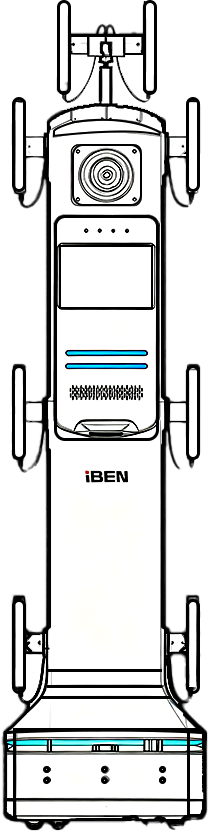
Unlike traditional AGVs tied to fixed paths, modern delivery robots for factories use laser SLAM, vision SLAM or sensor fusion to operate in mixed environments where people, forklifts and manual carts share the same aisles. iBEN’s X300 smart transport robot, for example, is designed specifically for industrial indoor handling scenarios, with dual SLAM navigation and real‑time obstacle avoidance. This allows it to adapt quickly when lines are reconfigured, buffer zones are moved, or temporary equipment is added to the shop floor.
A factory floor delivery robot is typically part of a wider system that includes fleet management, traffic control and integration with WMS and MES. Together, they form a closed loop from production demand signals, to material delivery, to feedback on task completion, ensuring that internal logistics supports rather than constrains the production schedule.
System Architecture: From Line-Side Signals to Robot Missions
The power of a factory floor delivery robot lies not only in its hardware, but in how it is connected to production systems. A typical architecture has three main layers: the robot layer, the scheduling layer and the integration layer.
At the
robot layer, each delivery robot handles local perception and movement. It builds and maintains maps, plans collision‑free paths and executes docking maneuvers with line‑side racks, lift tables or conveyors. For example, iBEN’s
X300 smart transport robot uses dual SLAM navigation and precise positioning to ensure reliable automatic docking with production equipment or storage fixtures.
The scheduling layer coordinates multiple robots across the factory floor. It decides which robot should handle which delivery, in what order, and along which route, while avoiding congestion at narrow corridors and intersections. In a distributed scheduling architecture, robots share information and make local decisions within global constraints, improving scalability and resilience compared with purely centralized systems.
At the integration layer, the factory floor delivery robot system connects with WMS, MES and sometimes PLCs on production equipment. When MES detects that a workstation’s material buffer is running low, it can automatically trigger a delivery mission; when a production batch is finished, it can create a task to move WIP or finished goods to the next process or to the warehouse. This integration transforms internal logistics from a manual, reactive activity into a programmable part of the production system.
Synchronizing Delivery Robots with Production Takt and MES
One of the biggest advantages of factory floor delivery robots is their ability to align internal logistics with production takt – the rhythm at which products must move to meet demand. When logistics is manual, line operators often have to chase materials or call forklift drivers at the last minute, leading to both shortages and congestion.
By connecting delivery robots to MES, factories can convert production plans and takt into concrete logistics missions. For example, MES can monitor line‑side inventory levels and consumption rates, and trigger replenishment missions when stock drops below defined thresholds. Robots then deliver the right materials to the right workstation just in time, keeping buffers within target ranges and avoiding line stops caused by missing parts.
iBEN’s manufacturing solutions emphasize this closed loop: smart transport robots like the X300 automatically dispatch in response to production line signals and support both semi‑automatic and fully automatic handling schemes. Integrated with MES and IoT devices, they help build a full “perception–decision–execution” loop where sensors, software and robots work together to maintain takt.
Typical Factory Floor Delivery Scenarios
Factory floor delivery robots can handle a wide variety of internal logistics tasks, but several scenarios are especially common across industries.
Line-Side Feeding of Raw Materials and Components Robots deliver raw materials, components or kits from the warehouse or supermarket areas to line‑side buffers. Missions are often triggered by MES based on consumption, or by electronic Kanban signals at workstations. In assembly lines, this can include small parts in totes, kitted modules on carts, or pallets of bulk materials.
Inter-Process Work-in-Process Transfers In multi‑stage manufacturing (e.g., machining → washing → assembly → testing), factory floor delivery robots move WIP between process steps. Instead of relying on dedicated operators or forklift runs, robots ensure consistent transfer times and reduce manual handling, which is particularly valuable for fragile or high‑value components.
Finished Goods and Empty Container Management Robots transport finished goods from the line end to inspection, packaging or the outbound warehouse. At the same time, they return empty containers, racks or pallets to upstream locations, closing the loop and minimizing the number of containers required.
Auxiliary Logistics Inside the Factory Delivery robots can also support auxiliary tasks such as moving tooling, fixtures, packaging materials or maintenance supplies between storage and consumption points. This helps reduce time spent on non‑productive walking and manual transport for technical staff.
These applications are combined within
iBEN Robot manufacturing solutions, which use the same smart transport robots to support diverse material flows across the factory.
Safety and Human–Robot Collaboration on the Factory Floor
Safety is a central concern on the factory floor, where people, forklifts and machines share limited space. Traditional forklifts pose significant risks, especially in narrow aisles or where visibility is restricted. Factory floor delivery robots are designed to improve this situation through advanced sensing and behavior control.
Robots typically use laser scanners, 3D cameras and bumper sensors to detect obstacles and people in their path. They enforce speed limits, slow down in congested areas and stop when objects or workers are detected within safety zones. iBEN’s forklift AGVs, for example, use laser SLAM + VSLAM fusion navigation and 360° environmental perception, eliminating the need for dedicated robot lanes or physical barriers in many cases.
Because routes, speeds and stopping behavior are preconfigured and monitored, robot movements are more predictable than manual forklifts, which can reduce accidents and near misses. Clear visual signals, audio alerts and standardized right‑of‑way rules further improve human–robot collaboration. Over time, operators can focus on tasks requiring judgment and skill, while robots handle standardized logistics motions.
Efficiency Gains: From Ad-Hoc Transport to Orchestrated Material Flow
The introduction of factory floor delivery robots turns ad‑hoc, operator‑driven logistics into orchestrated, measurable material flow. Studies and vendor data show that automatic handling robots can significantly improve throughput and resource utilization when deployed correctly.
By replacing manual cart pushing and many forklift runs, robots reduce non‑value‑added walking and unproductive travel. iBEN’s industrial handling robot platforms, such as the i300 series, combine 300 kg payload capacity with speeds around 1.2 m/s, supporting high‑intensity continuous operation and up to 40% improvements in handling efficiency compared with traditional manual handling.
Because missions are generated and tracked by software, the system can balance workload between robots, avoid congestion and maintain consistent delivery times. This directly supports stable production takt, reduces unplanned line stops and improves overall equipment effectiveness (OEE). Over time, data collected from robots and MES helps planners optimize buffer sizes, batch sizes and line layouts for even greater efficiency.
Cost and ROI of Factory Floor Delivery Robots
From a financial perspective, investment in factory floor delivery robots includes hardware, software, integration and ongoing operation, similar to warehouse AGV projects. Hardware prices vary with payload, navigation technology and safety requirements. For example, factory floor forklift AGVs generally cost more than small cart‑towing robots due to higher mechanical complexity and safety systems.
Total project budgets must also account for fleet management software, integration with MES/WMS, charging infrastructure and commissioning. According to cost analyses for industrial AGVs, overall system costs for multi‑vehicle deployments can range from several hundred thousand to a few million USD, depending on fleet size and complexity. Ongoing opex – maintenance, software licenses, energy and battery replacement – is typically significantly lower than the annual cost of the labor and forklift resources replaced, especially in multi‑shift operations.
ROI comes not only from reduced labor and equipment costs, but also from improved uptime, fewer quality issues from mishandled materials and better safety. For example, if delivery robots can reduce internal transport labor by 30–50% and also prevent a handful of expensive line stops each year, payback periods of two to four years are achievable in many factories.
Implementation Roadmap: From Pilot Line to Full Smart Factory
Successful deployment of factory floor delivery robots typically follows a phased roadmap rather than an all‑at‑once approach.
-
Assessment and Concept Design Factories start by analyzing current material flows, takt requirements and pain points such as frequent line stops or congestion. This leads to a concept design that identifies target processes, robot types, integration points and KPIs.
-
Pilot on a Single Line or Area A pilot implementation on one line or in one area allows the team to validate technology, integration with MES/WMS and operator workflows. Because dual‑SLAM robots like X300 can deploy with minimal infrastructure, initial pilots can often be set up and mapped within hours or days.
-
Scale Up to Multiple Lines and Shifts Once the pilot is stable and KPIs are met, the system can be expanded to additional lines, shifts and logistics flows. Distributed scheduling makes it easier to add robots without redesigning the entire system, and lessons learned in the first area can be reused elsewhere.
-
Full Smart Factory Integration In the long term, factory floor delivery robots become part of a broader smart factory ecosystem that also includes warehouse robots, industrial robots and IoT infrastructure. At this stage, internal logistics, production and warehouse operations are all coordinated through data and software, supporting highly flexible, responsive manufacturing.
Conclusion: Factory Floor Delivery Robots as the Backbone of Smart Manufacturing
Factory floor delivery robots are rapidly becoming the backbone of internal logistics in smart factories. By synchronizing material flow with production takt and MES signals, they help ensure that lines are supplied with the right materials at the right time, while improving safety and reducing manual workload.
With mature platforms like those from
iBEN Robot – including dual‑SLAM smart transport robots and integrated manufacturing solutions – factories can start with a focused pilot and gradually build toward a fully connected, data‑driven internal logistics system. In an era where flexibility, efficiency and safety all matter, factory floor delivery robots are a strategic enabler for manufacturers aiming to stay competitive.