Introduction: The Evolution of Industrial Automation
For decades, the image of an industrial robot was fixed: a massive, caged mechanical arm performing the same weld or pick operation thousands of times per day, isolated from human workers for safety. This paradigm served manufacturing well during the era of mass production, where change was slow and volume was king.
Today, the rules have changed. Manufacturers face shorter product lifecycles, increasing product variety, and pressure to respond rapidly to market shifts. Enter the smart industrial robot—a new generation of automation that is mobile, intelligent, and designed to work alongside people.
This article provides a comprehensive comparison between traditional industrial robots and smart industrial robots. We will examine seven critical differences, explore when each solution makes sense, and demonstrate how companies like iBEN Robot are helping manufacturers transition to more flexible, future-proof automation.
Defining the Contenders
What is a Traditional Industrial Robot?
A traditional industrial robot typically refers to a fixed-base manipulator—most commonly a 6-axis articulated arm—programmed to perform repetitive tasks with high speed and precision. These robots are the workhorses of high-volume manufacturing.
Key characteristics:
-
Fixed installation bolted to the floor in a dedicated location
-
Requires safety guarding behind cages or light curtains
-
Programmed for specific tasks; changes require reprogramming
-
Cannot perceive or adapt to environment changes
-
Exceptional repeatability for identical operations
Common applications: Automotive welding, heavy part handling, painting, palletizing of uniform loads.
What is a Smart Industrial Robot?
A smart industrial robot is an autonomous system equipped with artificial intelligence, advanced sensors, and software intelligence that enables it to perceive its environment, make decisions, and adapt to changing conditions. This category includes Autonomous Mobile Robots (AMRs), collaborative robot arms, and hybrid systems.
Key characteristics:
-
Autonomous navigation using SLAM and VSLAM technology
-
Human-safe operation through advanced perception
-
Software-defined functionality for easy task changes
-
Flexible deployment without facility modifications
-
Integration with WMS, ERP, and enterprise systems
Common applications: Material transport, machine tending, line-side feeding, warehouse logistics, in-process inspection.
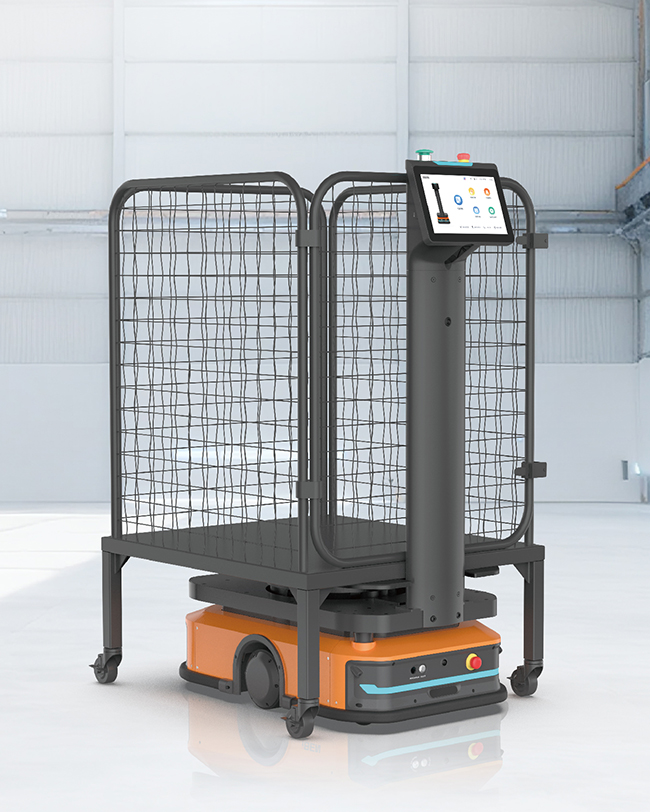
iBEN Robot's AMR handling robots exemplify this new category—mobile, intelligent platforms designed for industrial environments while maintaining flexibility to adapt to changing production needs.
Head-to-Head Comparison: 7 Critical Differences
-
Flexibility and Adaptability
Traditional Industrial Robot:
Traditional robots are designed for fixed, repetitive tasks. Their physical installation is permanent, and programs are written for specific operations. If a production line changes, the robot must be reprogrammed and sometimes physically relocated. This process is time-consuming, expensive, and requires specialized expertise.
Smart Industrial Robot:
Smart robots are fundamentally software-defined. Their paths, tasks, and behaviors are controlled through software, which can be updated in minutes. A smart industrial robot deployed for material transport today can be reassigned to a different route tomorrow without any physical modification.
iBEN Advantage: iBEN robots require no site modification and no system construction. They adapt to facility changes without costly infrastructure projects.
-
Deployment Time and Cost
| Deployment Factor |
Traditional Industrial Robot |
Smart Industrial Robot |
| Planning phase |
Months of engineering study |
Days of site assessment |
| Installation |
Weeks of construction |
Hours of robot mapping |
| Programming |
Specialized integrators |
In-house staff configuration |
| Safety integration |
Cages and certifications |
Built-in safety systems |
| Total time to operation |
3-12 months |
1-5 days |
Traditional Industrial Robot:
Deploying a traditional robot is a capital project requiring foundation preparation, power routing, and extensive programming. Total cost often exceeds purchase price by two or three times.
Smart Industrial Robot:
Modern smart robots emphasize rapid deployment. Advanced systems use natural environment features for navigation, eliminating facility modifications. iBEN Robot achieves same-day deployment in most scenarios with up to 80 percent lower deployment costs.
-
Navigation and Perception
Traditional Industrial Robot:
Traditional robots are blind. They execute pre-programmed motions without awareness of surroundings. If a part is out of position or a person enters the work envelope, the robot cannot perceive it. This is why they must be isolated behind safety barriers.
Smart Industrial Robot:
Smart robots perceive their environment continuously through:
-
LiDAR for mapping and obstacle detection
-
3D depth cameras for object recognition
-
Ultrasonic sensors for detecting transparent materials
-
Bumpers as a final physical safety layer
Sensor data is fused into a real-time world model for safe navigation and intelligent decision-making. iBEN's laser SLAM and VSLAM fusion technology ensures robust performance across varying conditions.
-
Safety and Human Collaboration
Traditional Industrial Robot:
Safety is achieved through separation. Physical cages and light curtains prevent human access while the robot operates. This approach consumes floor space and prevents close collaboration.
Smart Industrial Robot:
Smart robots are engineered for safe coexistence. Their 360-degree perception continuously monitors for people and obstacles. When a person approaches, the robot can slow down, stop, plan an alternative path, or resume when clear. This enables truly collaborative workflows.
-
Scalability
Traditional Industrial Robot:
Scaling means purchasing, installing, and integrating additional complete systems. Each new robot requires the same lengthy deployment process. Scaling is a step-function cost with significant capital requirements.
Smart Industrial Robot:
Smart robot fleets scale linearly and incrementally. The first robot requires mapping and configuration. Subsequent robots join the existing fleet, downloading the map and coordinating through distributed scheduling. This makes fleet expansion seamless without central server bottlenecks.
-
Integration with Enterprise Systems
Traditional Industrial Robot:
Traditional robots often operate as islands of automation. Deep integration with Warehouse Management Systems or Enterprise Resource Planning is complex and costly.
Smart Industrial Robot:
Smart robots feature open interfaces enabling seamless integration with:
-
Warehouse Management Systems (WMS)
-
Enterprise Resource Planning (ERP)
-
Manufacturing Execution Systems (MES)
-
IoT devices and building automation
-
Other robotic fleets
This connectivity transforms robots from isolated tools into integrated components of the digital factory.
-
Total Cost of Ownership (TCO)
| Cost Factor |
Traditional Industrial Robot |
Smart Industrial Robot |
| Initial hardware cost |
High |
Moderate |
| Installation and integration |
Very high |
Low to none |
| Programming and commissioning |
High |
Low |
| Changeover and reconfiguration |
High each time |
Low |
| Maintenance |
Specialized technicians |
Modular and simpler |
| Scalability cost |
Step-function |
Linear |
| Estimated 5-Year TCO |
3-5x initial purchase |
1.5-2x initial purchase |
While a traditional robot might have a lower purchase price in some cases, total cost of ownership over time often favors smart industrial robots due to adaptability and lower ongoing costs.
When Does Each Solution Make Sense?
Choose Traditional Industrial Robots When:
-
Ultra-high volume production with no variation
-
Extreme speed requirements below mobile robot capabilities
-
Hazardous environments where human proximity is impossible
-
Long product lifecycles of 5-10 years without change
-
Dedicated operations in one permanent location
Choose Smart Industrial Robots When:
-
Dynamic production with frequent changeovers
-
Material transport and logistics within the facility
-
Human-robot collaboration is required
-
Multiple SKUs and variable workflows
-
Rapid ROI justification is needed
-
Facility constraints prevent permanent infrastructure
-
Future-proofing against operational changes
Real-World Applications
Material Transport and Logistics
Moving materials between workstations, warehouses, and assembly lines eliminates worker walking time and ensures just-in-time delivery. iBEN's AMR handling robots offer payload capacities from 100kg to 1500kg, covering small parts to heavy pallets.
Machine Tending
Loading and unloading CNC machines, injection molders, and presses while coordinating with machine controllers.
Line-Side Feeding
Delivering parts to assembly stations just when needed, reducing workstation clutter and worker walking.
Warehouse Automation
Enabling goods-to-person picking, inventory transport, and putaway with real-time WMS integration.
The Technology Behind Smart Industrial Robots
Autonomous Navigation: SLAM and VSLAM
Simultaneous Localization and Mapping uses LiDAR to build environment maps while determining position. Visual SLAM adds camera data for recognizing landmarks. iBEN's dual SLAM fusion combines both approaches for robust operation in varied conditions.
Distributed Intelligence
Modern smart robots use distributed scheduling where robots communicate directly to negotiate traffic and coordinate tasks. This eliminates single points of failure and enables responsive fleet coordination.
How iBEN Robot Bridges the Gap
| iBEN Feature |
Benefit for Manufacturers |
| Dual SLAM Navigation |
Reliable operation in changing environments |
| 100kg to 1500kg Payload |
Wide range of material handling needs |
| 60cm Narrow Aisle Passage |
Operates in space-constrained facilities |
| 360-Degree Perception |
Safe human-robot collaboration |
| Distributed Scheduling |
Scalable fleets without bottlenecks |
| Open Integration APIs |
Easy connection to WMS and ERP |
| Same-Day Deployment |
Quick ROI and minimal disruption |
| 24/7 Operation |
Continuous multi-shift operation |
iBEN Robot brings nearly a decade of commercial robotics experience to industrial applications. As market leaders in reception and exhibition robots, they have refined reliable navigation, human-safe operation, and intuitive software. This expertise transfers directly to industrial products.
Making the Transition
Step 1: Assess Material Flow
Identify repetitive transport tasks, bottlenecks, and high-waste areas.
Step 2: Define Requirements
Document payload, frequency, distance, and integration needs.
Step 3: Pilot with One Robot
Start small to prove ROI and identify challenges.
Step 4: Integrate Systems
Connect to WMS or ERP for full automation.
Step 5: Scale the Fleet
Add robots incrementally as demand grows.
Conclusion
The choice between traditional and smart industrial robots is strategic. Traditional robots offer extreme speed for unchanging, high-volume tasks. Smart industrial robots offer flexibility, adaptability, and the ability to thrive in dynamic environments.
For most modern manufacturers facing product variation, customization demands, and pressure to respond quickly to market changes, smart industrial robots represent the more future-proof investment. Their ability to deploy rapidly, adapt to change, and integrate with enterprise systems delivers sustainable competitive advantage.
To learn how smart industrial robots can transform your operation, visit
iBEN Robot for more information or to schedule a consultation.