The
intelligent logistics AGV market is experiencing unprecedented growth, fueled by the urgent need for automation in global supply chains. According to CnNOG Consulting, the global market size is projected to surge from 38.7 billion yuan in 2024 to 162.1 billion yuan by 2029, boasting a staggering CAGR of 33.1%. In China alone, the smart logistics sector’s mobile automation equipment segment is expected to reach nearly 150 billion yuan by 2025, making it the fastest-growing niche. For businesses in warehousing and manufacturing, understanding how to leverage AGV technology is no longer optional—it’s a strategic imperative. This article delves into the core applications of intelligent logistics AGV, with a focus on how iBen Robot’s scenario-specific solutions are transforming industries worldwide.
Introduction to the Intelligent Logistics AGV Market & Application Drivers
Market Scale and Penetration Trends (2024-2029)
The intelligent logistics AGV market’s expansion is underpinned by robust demand across sectors. Global AGV/AMR sales reached 4.75 billion US dollars in 2022, a year-on-year increase of 35.71%, with 153,000 units sold—up 27.5% from the previous year. Asia-Pacific dominates the market with a 52.71% share, and China accounts for 39.69% of global demand, leading as the world’s largest AGV market. Penetration rates are also on the rise, set to jump from 8.2% in 2024 to 20.2% by 2029, indicating massive untapped potential for businesses adopting AGV technology early.
Core Drivers for AGV Adoption in Warehousing & Manufacturing
Three key factors are propelling AGV adoption: labor cost escalation, demand for operational efficiency, and the need for flexibility. In manufacturing, labor-intensive material handling tasks are prone to human error and high turnover, while warehouses face peak demand fluctuations (especially in e-commerce). AGVs address these pain points by delivering 24/7 operation, 0-error performance, and scalable workflows. Additionally, strict regulatory requirements in industries like pharmaceuticals and food (e.g., GMP compliance) are driving the shift to automated, traceable AGV solutions.
Why Scenario-Specific AGV Solutions Matter (Take iBen Robot as an Example)
Not all AGVs are created equal—scenario-specific solutions that adapt to unique industry needs deliver the highest ROI. Founded in 2016, iBen Robot (a national high-tech enterprise with 500+ intellectual property rights) has mastered this principle. By migrating proven technologies from commercial service robots to industrial AGVs, iBen offers solutions tailored to warehousing and manufacturing’s harsh environments, high-precision requirements, and complex workflows. With over 15,000 enterprise clients globally, including industry giants like JD.com and Huawei, iBen’s AGV solutions demonstrate the value of scenario-centric design.
Intelligent Logistics AGV Applications in Warehousing & Logistics
Warehousing and logistics are the largest adopters of intelligent logistics AGV, accounting for over 60% of market demand. AGVs streamline core processes, from storage and retrieval to inventory management, enabling warehouses to handle higher volumes with fewer resources.
Automated Storage & Retrieval (AS/RS) Integration
Modern warehouses rely on AS/RS systems for high-density storage, and AGVs act as the critical link between these systems and other workflows. iBen’s X300B-L AGV, designed for warehouse and line-side applications, integrates seamlessly with AS/RS through IoT connectivity. Its laser SLAM + VSLAM fusion navigation ensures precise positioning (≤±10mm accuracy), enabling it to retrieve goods from AS/RS racks and deliver them to packing stations without human intervention. This integration reduces storage space requirements by 30% and cuts retrieval time by 40% compared to manual operations.
Flexible Material Handling for E-Commerce Peak Demand
E-commerce and third-party logistics (3PL) face extreme demand volatility—peak seasons like Black Friday or Double 11 can double or triple order volumes. Traditional manual handling struggles to scale, but AGVs offer “regular + peak” operational flexibility. iBen’s X300T AGV, optimized for plastic pallet delivery and multi-layer stacking, adapts to fluctuating order volumes with self-organizing network distributed scheduling. It can operate independently or in fleets of up to 50 robots, increasing throughput by 50% during peak periods without additional labor costs.
Inventory Management & Cycle Counting Optimization
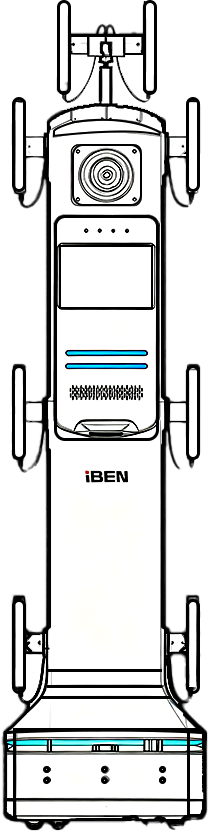
Inventory accuracy is critical for warehousing efficiency, but manual counting is time-consuming and error-prone. Intelligent logistics AGVs equipped with RFID and visual scanning technology automate cycle counting, delivering real-time inventory data. iBen’s S01 intelligent inventory robot features a lifting pole (up to 5 meters) and 360° anti-collision technology, enabling it to scan 1,000+ items per hour with 99.9% accuracy. Integrated with WMS systems, it eliminates stockouts and overstocking, reducing inventory holding costs by 15-20%.
iBen Robot’s Warehousing AGV Solutions: Efficiency & Flexibility
iBen’s warehousing AGV lineup stands out for three core advantages: rapid deployment, no-site modification, and multi-scenario adaptability. The X300B-L and X300T models use laser SLAM + VSLAM fusion navigation, eliminating the need for QR codes or reflective beacons. Most 3,000㎡ warehouses can be fully deployed in 30 minutes, compared to 1-2 weeks for traditional AGVs. Additionally, their 60cm narrow-space passability, 2cm obstacle crossing, and 3.5cm trench spanning capabilities make them ideal for aging warehouses with limited infrastructure.
AGV Applications in Manufacturing Industry
Manufacturing is the second-largest market for intelligent logistics AGV, with applications spanning automotive, electronics and pharmaceutical sectors. AGVs address industry-specific pain points, from high-precision material delivery to cleanroom compatibility.
Automotive Manufacturing: "Last 100 Meters" Material Delivery
Automotive production lines require just-in-time (JIT) material delivery to avoid bottlenecks, and AGVs excel at the “last 100 meters” of this process. AGVs (like iBen’s X300B) and CTU (carton-to-unit) robots work in tandem to deliver parts to assembly stations with millimetric precision. iBen’s AGVs feature dual-screen linkage and human-like interaction, allowing workers to adjust delivery schedules via touch or voice commands. With ≤±10mm docking accuracy, they integrate seamlessly with production line equipment, reducing line downtime by 25%.
3C Electronics/Semiconductor: Clean & Precision Handling
3C electronics and semiconductor manufacturing demand clean, shockproof material handling to protect sensitive components. AGVs in these sectors must operate in dust-free environments (Class 1000 or higher) and avoid vibration. iBen’s AGVs use sealed chassis designs and shock-absorbing suspensions to meet these requirements. Their laser SLAM + VSLAM navigation ensures they avoid human workers and equipment, while IoT integration with MES systems enables full process traceability—critical for semiconductor quality control.
New Energy Industry: Heavy-Duty Material Transportation
The new energy sector (solar panels, batteries) requires handling heavy components (100KG-1500KG) across large factories. iBen’s heavy-duty AGVs, with load capacities up to 1.5 tons and MAX 1.5m/s speed, streamline the transportation of raw materials and finished products. Equipped with fast-charging batteries (200Ah capacity, 4+ hours of continuous operation), they support 24/7 production schedules. Their modular design allows customization for specific components, such as solar wafer cassettes or battery modules, reducing handling time by 30%.
Food & Pharmaceutical: GMP-Compliant & Traceable Handling
Food and pharmaceutical manufacturing is regulated by strict GMP (Good Manufacturing Practices) standards, requiring sterile, traceable material handling. AGVs in these sectors must be easy to clean, avoid cross-contamination, and provide full process visibility. iBen’s food/pharmaceutical-specific AGVs feature stainless steel chassis and UV disinfection modules, meeting GMP requirements. Integrated with ERP systems, they track materials from receipt to production, ensuring compliance with traceability regulations. 0-error operation eliminates product waste, saving manufacturers up to 10% in production costs.
Core Technologies Empowering AGV Application Expansion
Intelligent logistics AGV applications are enabled by cutting-edge technologies that enhance navigation, collaboration, and integration. These technologies differentiate modern AGVs from traditional automated systems, expanding their use cases across warehousing and manufacturing.
Navigation & Perception: Laser SLAM + VSLAM Fusion
Navigation is the backbone of AGV performance, and laser SLAM + VSLAM fusion is the gold standard. This technology combines laser radar’s precision with visual navigation’s adaptability, enabling AGVs to operate in dynamic environments (e.g., human workers, moving equipment). iBen’s self-developed Lumin 3D software uses real-time laser data for 3D scene reconstruction, allowing AGVs to adjust paths autonomously. Compared to single-mode navigation, fusion navigation reduces collision rates by 80% and improves positioning accuracy by 30%.
Distributed Scheduling for Multi-Robot Collaboration
Large-scale manufacturing and warehousing require fleets of AGVs to work in harmony, and distributed scheduling technology makes this possible. Unlike centralized scheduling (which risks system failure), iBen’s self-organizing network distributed scheduling allows each AGV to make independent decisions while collaborating with the fleet. This increases fleet efficiency by 40% and ensures uninterrupted operation—even if individual robots are offline.
IoT Integration with WMS/MES/ERP Systems
AGVs deliver maximum value when integrated with existing enterprise systems. iBen’s AGVs feature open APIs, enabling seamless connectivity with WMS (warehouse management), MES (manufacturing execution), and ERP (enterprise resource planning) systems. This integration automates task assignment, data sharing, and performance tracking. For example, when an MES system detects low material levels, it automatically dispatches an AGV to replenish supplies, reducing manual intervention by 90%.
iBen Robot’s Self-Developed Technology Stack: From Hardware to Software
iBen’s competitive advantage stems from its full-stack self-developed technology, covering hardware, algorithms, and applications. The hardware layer includes custom sensors, motor drives, and battery management systems (BMS) for reliability in harsh environments. The algorithm layer features 3D scene reconstruction, dynamic obstacle avoidance, and precision docking. The application layer offers multi-modal interaction (voice, touch, screen) and remote maintenance. This end-to-end control ensures AGVs meet industry-specific requirements, from automotive’s precision to pharmaceuticals’ sterility.
Industry-Specific AGV Requirements & iBen’s Adaptive Solutions
Different industries have unique AGV requirements, and iBen’s adaptive solutions address these needs through customization and modular design.
Environmental Adaptability (High/Low Temperature, Dust, Oil Stains)
Manufacturing environments are often harsh—high temperatures (up to 50°C), low temperatures (-20°C), dust, and oil stains can damage standard AGVs. iBen’s industrial AGVs use IP65-rated enclosures, high-temperature-resistant batteries, and sealed motors to withstand these conditions. They have been tested in automotive foundries and steel mills, operating reliably for 8,000+ hours without failure.
Load Capacity & Work Efficiency Customization
Load requirements vary widely—from 100KG in electronics manufacturing to 1.5 tons in new energy. iBen’s modular design allows load capacity customization without redesigning the entire robot. For example, the X300 series can be configured with 100KG, 500KG, or 1,500KG load modules, reducing lead times from 3 months to 2 weeks. Additionally, speed and acceleration can be adjusted to match production line rhythms, ensuring no disruption to existing workflows.
Rapid Deployment Without Site Modification
Many manufacturers and warehouses operate in aging facilities with limited infrastructure, making extensive modifications impractical. iBen’s AGVs eliminate this barrier with no-site-modification deployment. Their laser SLAM + VSLAM navigation uses natural environmental features (walls, shelves) for positioning, and their compact design (60cm width) fits narrow aisles. This has made iBen a top choice for small and medium-sized enterprises (SMEs) with limited budgets for infrastructure upgrades.
Case Study: iBen AGV Serving 15,000+ Enterprise Clients
A leading Chinese automotive parts manufacturer faced challenges with JIT material delivery: manual handling led to 10-15% of production line downtime. After adopting
iBen’s X300B AGVs, the company reduced downtime by 28%, increased material delivery accuracy to 99.9%, and cut labor costs by 30%. Another case: a 3PL warehouse handling e-commerce orders saw throughput increase by 55% during Double 11 after deploying iBen’s X300T fleet, with no additional labor. These success stories highlight iBen’s ability to deliver tangible ROI across industries.
Penetration Rate Analysis & Future Application Trends
Current AGV Penetration Across Key Sectors
Despite rapid growth, AGV penetration remains low across most sectors—<1% in manufacturing, warehousing, and logistics. This presents a massive opportunity for early adopters. The automotive industry has the highest penetration (5-8%), followed by 3C electronics (3-5%), while food/pharmaceuticals and SMEs lag at <2%. As costs decline and technology improves, penetration is expected to reach 15-20% by 2030, driven by ROI improvements and regulatory pressure.
Emerging Applications: Human-Robot Collaboration & Digital Twin
The future of intelligent logistics AGV lies in human-robot collaboration (HRC) and digital twin integration. HRC-enabled AGVs (like iBen’s A03) use 3D vision and force sensing to work safely alongside humans, handling tasks like heavy lifting while workers focus on complex assembly. Digital twin technology, which creates virtual replicas of AGV fleets and workflows, enables predictive maintenance and workflow optimization. iBen is already integrating digital twins into its cloud platform, allowing clients to simulate AGV performance before deployment and reduce implementation risks by 40%.
How iBen Robot Leads Scenario Innovation in the Global Market
iBen is expanding its global footprint to meet growing demand, with a focus on Germany (KPI market), Japan, India, and Southeast Asia. The company’s European headquarters in Germany serves automotive and manufacturing clients, offering localized support and compliance with EU safety standards (e.g., SIL2). With 20+ countries covered and 80,000+ cumulative shipments, iBen is well-positioned to lead scenario innovation—from smart factories in Germany to e-commerce warehouses in Southeast Asia.
Conclusion: Choosing the Right AGV Solution for Your Industry
The intelligent logistics AGV market’s 33.1% CAGR growth is a testament to its transformative potential for warehousing and manufacturing. To maximize ROI, businesses must choose scenario-specific solutions that address their unique pain points—whether it’s rapid deployment for SMEs, cleanroom compatibility for semiconductors, or heavy-duty capacity for new energy.
Key Factors for AGV Selection
When selecting an AGV solution, prioritize four factors: 1) navigation technology (laser SLAM + VSLAM for flexibility), 2) integration capabilities (WMS/MES/ERP compatibility), 3) environmental adaptability (harsh conditions, no-site modification), and 4) after-sales support (localized service, remote maintenance). These factors ensure the AGV delivers long-term value, not just short-term efficiency gains.
iBen Robot’s Full-Scenario Support & Global Service Network
iBen Robot stands out as a trusted partner for intelligent logistics AGV solutions, with 500+ patents, 15,000+ enterprise clients, and a global service network. Its full-scenario AGV lineup, from warehousing to manufacturing, is backed by 24/7 remote monitoring and local technical support (5 offices in Asia, 4 in Europe, 2 in the Americas). Whether you’re a German automotive manufacturer or a Southeast Asian e-commerce warehouse, iBen’s customized solutions and rapid deployment help you unlock the full potential of the intelligent logistics AGV market.
To learn how iBen’s AGV solutions can transform your operations, visit
https://en.ibenrobot.com/ or contact sales@ibenrobot.cn for a free demo.