Intelligent logistics AGV systems represent a fundamental shift from traditional automated guided vehicles to truly autonomous mobile robots capable of adaptive decision-making and dynamic navigation. While conventional AGVs follow fixed paths defined by magnetic strips or QR codes, intelligent systems use laser SLAM and visual recognition to navigate changing environments without infrastructure modifications. This technological evolution delivers dramatic improvements in deployment speed, operational flexibility, and total cost of ownership for warehousing and manufacturing operations.
The market for intelligent logistics AGV has expanded rapidly as businesses recognize the limitations of traditional automation approaches. Fixed-infrastructure systems require extensive installation time, constrain layout flexibility, and demand expensive modifications when operational needs change. Intelligent AGVs eliminate these constraints through beacon-free navigation that adapts automatically to new obstacles, route requirements, and facility layouts. Leading solutions like iBEN Robot's X300 series can be deployed in just 30 minutes and reconfigured instantly as business needs evolve.
Core Technologies Enabling Intelligent Operations
The foundation of intelligent logistics AGV performance lies in advanced sensor fusion and autonomous decision-making capabilities. Modern systems combine laser SLAM for precise geometric mapping with visual SLAM for feature recognition, creating comprehensive environmental understanding that operates reliably across varying conditions. This dual-sensor approach provides redundancy—if lighting conditions degrade visual perception, laser sensing maintains navigation capability, and vice versa.
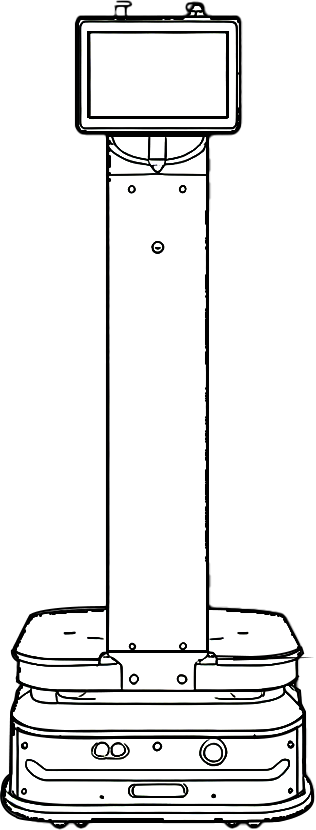
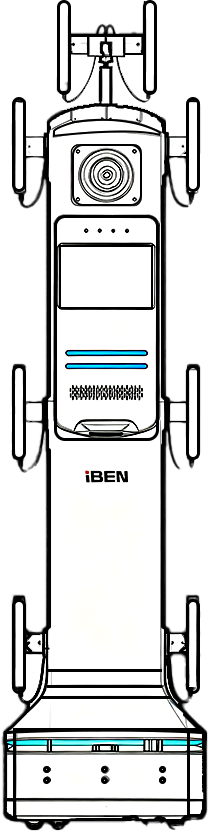
iBEN's X300 platform exemplifies this fusion approach, achieving ±5cm high-precision navigation without requiring any facility infrastructure. The system recognizes industrial scene features adaptively, automatically adjusting to layout changes, temporary obstacles, and varying lighting without human intervention or reprogramming. Navigation point accuracy reaches ±20mm and ±2°, with endpoint positioning precision under ±10mm and ±1°, enabling reliable operation in demanding applications from semiconductor cleanrooms to automotive production lines.
Fleet coordination architecture distinguishes intelligent logistics AGV from simpler alternatives. Self-organizing networks enable robots to communicate in real-time, sharing information about current tasks, positions, routes, and environmental conditions. Unlike centralized scheduling systems that create single points of failure and computational bottlenecks, distributed coordination allows autonomous task allocation and path optimization across the entire fleet. This approach scales seamlessly from small pilot deployments to large fleets managing 50+ robots without architectural redesign.
Operational Advantages and Performance Improvements
Intelligent logistics AGV systems deliver measurable performance improvements across multiple operational dimensions. Deployment time reductions prove especially dramatic—traditional AGV installations requiring 3-7 days for magnetic strip or beacon placement compress to 30-minute setup periods for intelligent systems. This 95% time reduction enables rapid pilot testing, quick scaling, and immediate reconfiguration when operational priorities shift.
Navigation accuracy improvements translate directly to operational efficiency and quality. Traditional AGVs typically achieve ±50mm positioning accuracy, adequate for simple transport but insufficient for precision applications. Intelligent systems reach ±5mm accuracy, enabling tight-tolerance operations like semiconductor wafer handling and electronics assembly component delivery. This precision reduces handling errors, minimizes product damage, and enables higher-density storage configurations.
System uptime and operational hours expand dramatically with intelligent logistics AGV compared to manual alternatives. Human operators work 8-hour shifts with breaks, limiting daily utilization to perhaps 7 productive hours. Intelligent AGVs operate 22-23 hours daily, pausing only for automated battery charging and minor maintenance. This continuous operation delivers 3x the daily productivity of single-shift manual handling, with even greater advantages in multi-shift facilities.
Industry Applications and Use Cases
Semiconductor manufacturing presents particularly demanding requirements that intelligent logistics AGV excel at addressing. Cleanroom environments prohibit magnetic tape installation and minimize QR code markers due to contamination concerns. Beacon-free navigation operates without facility modifications while maintaining the sub-centimeter accuracy required for delicate wafer transport. The iBEN X300's infrastructure-free approach makes it especially suitable for cleanroom deployments where traditional AGVs prove impractical.
Automotive parts logistics requires coordinated material delivery supporting just-in-time production systems. Intelligent AGVs handle heavy components up to 300kg while synchronizing automatically with assembly line rhythms. Integration with manufacturing execution systems enables real-time inventory tracking and automatic replenishment based on production consumption. The self-organizing fleet capabilities manage multiple concurrent deliveries across complex production facilities without manual coordination.
E-commerce distribution centers demand flexible, scalable material handling for highly variable order volumes and product mixes. Intelligent logistics AGV fleets expand or contract dynamically based on demand patterns, with self-organizing capabilities enabling rapid scaling during peak periods like holiday seasons. Integration with warehouse management systems automates order picking workflows, with robots autonomously transporting products from storage to packing stations based on real-time order priorities.
Implementation Strategy and Deployment Process
Successful intelligent logistics AGV deployment begins with comprehensive facility assessment and workflow analysis. Understanding current material flow patterns, identifying bottlenecks, and establishing baseline performance metrics provides the foundation for solution design and ROI validation. Leading suppliers like iBEN Robot conduct detailed site surveys examining aisle widths, floor conditions, integration requirements, and operational patterns.
Pilot implementations validate technology and demonstrate business value before full-scale commitment. The rapid deployment capabilities of intelligent systems enable quick pilot initiation—iBEN's 30-minute setup allows same-day operational testing. Deploying 2-3 robots in a representative workflow over 4-8 weeks provides sufficient performance data to validate throughput improvements, accuracy gains, and ROI projections. Pilot results inform full deployment planning and identify optimization opportunities before scaling.
Full-scale deployment proceeds in phases to manage risk and demonstrate progressive value delivery. Initial phases target high-volume material flows offering clear ROI, typically core production support or primary warehouse zones. Subsequent phases expand to supporting processes and lower-volume areas. The self-organizing network architecture of intelligent AGVs simplifies scaling—adding robots requires no complex reprogramming or system reconfiguration, just introducing new units to the existing fleet.
Cost Analysis and Return on Investment
Intelligent logistics AGV systems typically cost $28,000-$45,000 per unit for medium-duty robots handling 200-300kg loads. Total implementation costs include fleet management software, integration services, charging infrastructure, and training programs. A representative 15-robot deployment might require $650,000-$750,000 in initial investment including all components and services.
Return on investment derives from multiple value sources. Labor cost reductions prove most immediate and measurable—a 15-robot fleet typically replaces 4-6 full-time material handlers per shift, generating $300,000-$400,000 in annual labor savings for multi-shift operations. Productivity improvements through optimized routing and continuous 24/7 operation increase throughput 30-50%, creating capacity for revenue growth without facility expansion. Quality enhancements reducing picking errors from 4-5% to under 1% prevent costly mistakes and customer dissatisfaction.
Leading intelligent logistics AGV solutions achieve 3-6 month payback periods through these combined benefits. Five-year ROI typically exceeds 300-500% when accounting for labor savings, productivity gains, quality improvements, and space optimization. The rapid payback and strong returns explain the accelerating adoption of intelligent AGV systems across warehousing and manufacturing operations globally.
Selecting the Right Intelligent Logistics AGV Partner
Choosing an intelligent logistics AGV supplier requires evaluating technology capabilities, implementation support, and long-term partnership potential. Navigation technology assessment should verify actual autonomous capabilities rather than marketing claims—request demonstrations in dynamic environments similar to your operations. Fleet coordination architecture determines scalability—self-organizing networks scale more effectively than centralized systems.
Integration flexibility affects implementation timeline and total cost. Suppliers offering comprehensive IoT connectivity and pre-built WMS/MES integration modules reduce custom development requirements. Open architectures supporting standard protocols like OPC UA and MQTT enable connections with diverse systems. Deployment speed capabilities directly impact project costs—30-minute setup solutions minimize expensive installation services.
Service and support infrastructure ensures long-term operational success. Verify supplier service network coverage in your operating regions and confirm response time guarantees for critical issues. Training comprehensiveness affects how quickly your team achieves operational proficiency and self-sufficiency. Software update policies determine whether systems receive continuous improvements or remain static after purchase.
iBEN Robot combines advanced fusion navigation technology, rapid deployment capabilities, comprehensive integration support, and extensive service infrastructure serving 15,000+ global clients. Their intelligent logistics AGV solutions deliver the autonomous capabilities, flexibility, and ROI required for modern warehousing and manufacturing operations. Visit
https://en.ibenrobot.com/ to explore their intelligent AGV portfolio and request a customized assessment for your facility.